
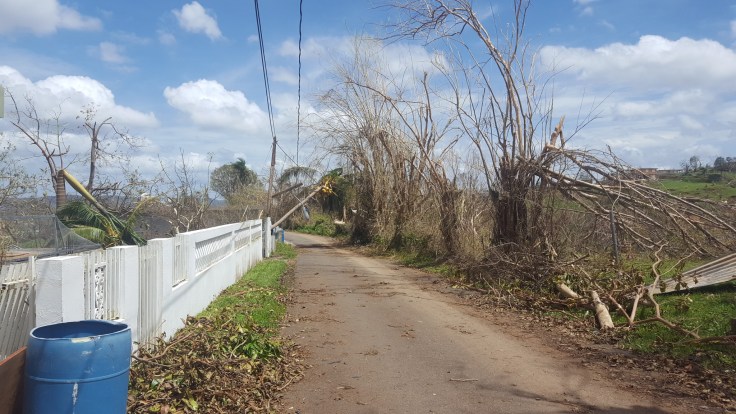
Today marks the eighth anniversary of Hurricane María (September 20, 2017). I still feel this date in my bones. It went beyond this day and, in many respects, is still present. This day brings a chilling, pre-Halloween horror sensation and, at the same time, a profound respect and awe for all her force, all she taught me, and all she exposed to the collective. I think of what has changed since and what has remained the same.
I cannot speak to our healing since María. I don’t know how we have healed as a collective or if we have healed anything. It’s hard to say when we tried to stand up from María’s rolling surf of PTSD but were knocked in the head over and over again by repeating waves of earthquakes. It is hard to say when we tried to move through fear and living on the edge but were covered by the Coronavirus tsunami. It’s hard to say when colonialism was alive and well before this trifecta and continues today. It’s hard to say when our vulnerability of these past eight years has been exploited to rezone Puerto Rico, seize more properties, lands, coastlines, and sack more resources. Rents and property costs have tripled in some cases. Most recently, along with ICE, the US sends its military to our lands, air and seas again, training to invade our neighbors.
This leads me to what has stayed the same. The lights still go out. Over the past month, at our house, we lose water on average 3 days a week, every week. The US president today is the same as during María, with his infamous paper-towel toss. An opportunitist, self-loathing, pro-statehood governor is in office again, making decisions in favor of the empire while selling out their own people.
My husband and I, our Gen X selves, talk about what we feared as children. There were indeed legitimate fears, while others were invented, sensationalized, imposed fears, much like today. As an adult, I crafted my home as a sanctuary, a space that my family and I would always feel safe in. María turned that notion on its head by busting in some windows and a door like she was coming to rob us. She spread puddles that took over our upstairs and downstairs floors even though we lived up on a hill, near no water sources. Her sideways rain blown into our windows cascaded down the stairs like a waterfall. She did shit I never thought possible. As already stated, I was simultaneously horrified and in awe. Then the earthquakes came and shook us out of our beds, up from the dinner table, out of our homes. Both María and the earthquakes took whole houses out. And when we all had our nervous systems shot from that double threat, in came Coronavirus carried in by our own bodies, spread to loved ones. No place was safe it seemed. It was a whole other level of fear. There was no running home for safety. The threats pushed their way in or were already there lurking.
This brings me to the idea of safety on a wider scale. How many Boricuas, people, over the past century, flocked to the US for stability and safety? How many stay for this very reason. I left the states in 2014 because I had a sense that I was NOT at home. It did not feel like a sanctuary space to me. For this, I was called crazy.
María blew all Boricuas into the same catastrophic circumstances. Neighbors came together, helped one another, helped each other survive. But let’s go back a little further than eight years. Let’s go back twenty years to Katrina. These two storms have something in common for the destruction they brought, but mostly for the government neglect of the most vulnerable communities and the losses that ensued as a result. During and post-Katrina, neighbors also came together, helped each other. But when black people were the most affected after the levees broke sending parts of the city underwater, and aid arrived late, it did so in the form of the National Guard pointing rifles at hungry faces. The victims, already in survival mode, were criminalized. Why was I 2025 years old when I learned these details during the recent Katrina anniversary? It took me twenty years to know the deepest atrocities that went down in post-Katrina New Orleans. One white man shot three black men, for being black, while they tried to board a ferry at Algiers point to evacuate. I sat with these and other revelations while watching the anniversary documentary series Katrina: Come Hell and High Water directed by Spike Lee, Geeta Gandbhir, and Samantha Knowles. While watching the National Guard deployed again to US cities.
People called me crazy for leaving nine years after Katrina. People called me crazy for staying home in Borikén after María. But the craziest thing, to me, is claiming to be safe in the US today. And if we don’t feel directly threatened, believing that as colonial subjects-US-Passport-holding-second-class-citizens we’re safe, how do folks sit comfortably while our neighbors are taken each day? How is anyone safe when parents, resources and rights are taken away daily, orphaning children, history, legacies?
The most catastrophic event is that of a collective lovelessness and inhumanity waged in the US today, waged on Gaza, the Congo, Sudan and more. Unfortunately, it sometimes takes these natural disasters to remind us that we are and should be in this together. But when they pass, how quickly we forget. How quickly everyone returns to their own corners. How swiftly do the goriest details of Katrina, of María, of colonialism, of ethnic cleanse and genocide get buried. Those who dare speak them are censored, detained, deported, disappeared. The most catastrophic hurricanes are the ones in office, voted for, elected by enough people to subject the rest to this collective mess.
María, like birthing, like rematriation, taught me so much about fear. About pushing past it, through it, like she did when she blew and blew till it felt like the house would explode, but she blew anyway. She blew to the breaking point—the pressure building in my stomach, knowing that something would explode and just as I hurried my children to huddle in the bathroom, I watched a tormentera, a plywood panel we covered our windows with, fly away. We only stayed a short while in that bathroom before she blew out the windows right next to it. María blew winds well beyond our breaking point. She taught me that I can stand past the breaking point. That just like she was stronger than I could ever imagine, so am I. Birthing taught me to push past pain, past fear, in order to create.
Ever notice how the empire aims to destroy, never create? Fear is the new pandemic. It is a virus unleashed by empire that seeps into our cells, our hearts and minds, invades our homes, families, communities, countries. Here is where we push past fear to birth what it is we came for. By leaning into the lessons of natural disasters, we learn to stop normalizing manmade catastrophes while calling hurricanes freak events. Those who force families apart, who displace, dispossess, detain, deport, dominate are the freakiest horror display one can witness. María exposed the empire. She taught us, like nature, to reverdecer after the storm, sprouting, growing, flourishing again as a maximum expression of free, authentic life and purpose, versus responding to disasters, to injustice with complacency, conformity and complicity.
 Rematriating Borikén
Leave a comment