
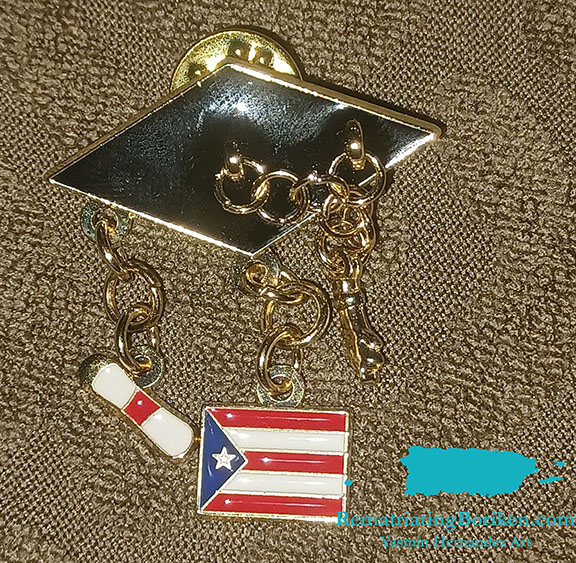
A series of memories spark in my mind as I look down at this pin that my son wore on his 8th grade graduation gown earlier today. I spent the afternoon reflecting on the ceremony, its highlights, his growth and development. I think of the ways this journey has been a whole rite of passage for our family and how this moment, twelve years into our new life in Borikén, feels like an initiation. Tired and still stuffed from a celebratory lunch, the family disperses. I stand in the golden hour glow of sunset filtering into our sala through sugar cane leaves that have crept into our second floor balcón. We can cut down the stalk but instead, for weeks, we just tilt around her as we come up the stairs, accommodating her as she beautifully takes up space. Facing her through the living room window, I hover over the sofa, putting away his gifts, tucking the green graduation gown into that annoying too-long plastic that comes from the cleaners. That is how I ended up with the little pin in my hand. He and his fellow graduates were gifted these to wear during the ceremony. A black enamel graduation cap with a gold chain as tassel. From this little chain hangs three tiny charms: a diploma, another that looks like an azabache, and a Puerto Rican flag.
This tiny graduation pin with the Puerto Rican flag takes me back to when I was 16, the first time I decided to embark on a self-education process. I was a student at LaGuardia High School for the Arts in Manhattan. That same year, my father had started this oral history process with me, explaining our cultural and political history. Curious and wanting to advance my studies, I went to the school library and requested a book on Taíno culture. There were none, but the librarian offered to order one. The book arrived two weeks later, a book at fourth grade reading level. Though I was in the eleventh grade, I was beyond happy to have it in my hands. For art studio that semester, I painted an aerial view of a yucayeque with bohíos.
Decades later, as a mom of two, I’ve come a long way, not for the education I received but for always combining this parallel path of self-education around those suppressed histories. Whether in high school or the seven libraries on Cornell University’s campus, searching for books about our political history or venturing elsewhere till I got the information I needed. It was a struggle, pero lo logré. I challenged myself to read books in Spanish, expanding my vocabulary. Working at Taller Puertorriqueño in Philadelphia, I hit the jackpot with their bookstore. With each paycheck, I would get more books, beautiful books with luscious covers like a black and white photo of Harvard graduates Don Pedro y Doña Laura that I have also reproduced in my art. While at graduate school at Rutgers, I did an independent study with Dr. Olga Jiménez de Wagenheim, one of our most incredible Boricua historians. I would leave my queens apartment to study at Newark but all the Boricua history books I was seeking were up at the Aguilar Branch of the New York Public library in East Harlem. More train rides, more books, more history. Despite my continued passion, I didn’t complete my master’s in history. I decided instead to continue my commitment via my art and activism, a path that led me to leave New York City altogether and move to Boriken with our babies. It is crazy to consider myself back then at 16, just beginning this rematriation journey, and now as mom to two teens.
Boricua rematriation goes well beyond a move, and for some on this journey, they’ve been here all along, never left, never moved, still rematriating. Others move, arrive and are just as exploitive as the colonizers. They ain’t rematriating. I recognize that I began my rematriation journey as that 16-year-old Brooklyn teen in pursuit of her own history. For all that isn’t discussed around Boricua rematriation as reclamation, life practice, liberation strategy, there is another part of the story that isn’t often talked about, even among those claiming rematriation as their journey. This lil graduation pin got me thinking of all the babies who do not have a choice, who are moved by parents who migrate.
Our children were brought on this journey to Borikén from Queens, New York. We decided to move here when they were two and five. We left when we did because our oldest was to start kindergarten. We didn’t want to shock him with the transition of starting school in New York City, in English, nonetheless, making his little friends and then moving him to Puerto Rico to immerse in a classroom where the children only spoke Spanish. We didn’t want him to suffer the inverse of what our parents and other relatives experienced in arriving to New York. We left in May of 2014 with the intention of arriving here before schools closed so we could find one to register him for kindergarten.
We just celebrated twelve years here in Borikén. At the start of this month, May 1st, our oldest son celebrated his Move-Up ceremony where the school recognized the graduating seniors and the juniors who were “moving up” to the new seniors. Our son will be starting twelfth grade, and I write this reflection as we close out the month with our youngest just having graduated from the 8th grade.
There are many complexities on this journey—the journey back home to a place my father would talk to me about during car rides from my high school on the west side of Manhattan, back to East New York, Brooklyn. The path to reclaim, reconnect with our history. That little kindergartener is now seventeen years old. His brother is fourteen. Our journey is marked by education milestones from Kinder to all sorts of graduations and initiations. Looking down at this pin of my baby-turned 8th grade graduate, about to start high school, and this lil Boricua flag dangling, I think of how much that Brooklyn girl I was needed a pin like this. Moments like this affirm our presence here—the ability to spare them the long searches for home and instead immerse them in it.
I don’t know if they know, for as much as I tell them, how hard it was for me to have access to this history. I don’t know how much they realize how special it was to witness them hanging out with some of my heroes that I had mostly known through my books and through the oral histories of my elders. They didn’t notice because they were toddlers or children who went everywhere with a lil maletita filled with Hot Wheels. They weren’t thinking that Rafael Cancel Miranda was sitting in a chair at his annual Mayagüez birthday celebration. They just spread those lil cars out by his feet and started a lil kids party under that tent. My eighth-grade graduate may not remember that time I was relieved that he spilled the orange creamsicle Dylcia Pagán made him. I didn’t have the heart to tell her that he had an intolerance to milk, as she loaded his glass with heaping scoops of vanilla ice cream that she bathed in orange-flavored soda right before our three-hour drive from Loiza to Moca.
I don’t know if they know, for however much I tell them, just how arduous a journey it was to recover this history. They now have a history teacher who barely uses the textbook because he prefers to teach them beyond. Beyond teaching the three different political status options for Puerto Rico, when he gave the lesson on the independence option, instead of learning just about el Partido Independentista de Puerto Rico, my kid had pages and pages of notes with decades of pro-independence organizations that have existed.
I don’t know if they know how my heart exploded today when they sang their class song at graduation and it was “Boricua en la Luna” as sung and composed by Roy Bown and as written by patriot Juan Antonio Corretjer. Their teacher had them memorize and recite this poem last semester. While practicing it at home my kid would freestyle his own interpretations: “Yo sería borincano aunque naciera en Jupiter!” I used to sing them this song as a lullabye when they were babies. It was inspired by former political prisoners, sisters Ida Luz and Alicia Rodríguez and tells the story of their parents who left Puerto Rico for the states, always longing for home, but never being able to return. Alicia and Ida Luz did return, together with their comrades, in the most epic declaration of collective rematriation following their 1999 release from federal prison.
We’ve come a long way from May 2014 when we arrived but had no idea what we arrived to. Occupying someone’s home temporarily, we were told two weeks after our arrival that we would have to leave that home because it was being sold. We didn’t have any work lined up; we just came with a dream at a time when the world believed that the only dream was the American dream. We came here in pursuit of a different dream. While others flock out to study on other shores, we had this commitment to have our children study here. We were told by many that we would fail, but our expectations of success don’t look like “others’” expectations. We have always done it differently. That is why these babies were born in our Ozone Park Queens apartment. That is why we flew south when everyone still believed that the north was salvation. We still do things differently, while watching the salvation myth unravel up north, from a distance.
They did a procession into the graduation today as their names were read one at a time. They repeated the process to receive their diplomas and again as they exited the space. The teacher made it a point to read every individual kid’s full name again for like the third or fourth time, and in between each name she paused for the people to clap for each child in this parade exiting the graduation ceremony. I started recording early so I could capture my son’s name being read out loud and as he made his exit, this kid whose childhood has been marked by shyness, especially in crowded places. I recorded him as he proceeded with his procession out of the auditorium, watched him take a few steps down the aisle then turn his back to the audience and begin to moonwalk the rest of the way out of the space. Everyone, myself included, exploded in applause and laughter!
For me it was the highlight of the ceremony! It was the boldness and the courage to be different, to turn around and moonwalk his way out of there. His ancestral namesake, my graf artist/DJ/b-boy brother, who made it a point to crack jokes every time he saw someone looking sad and wouldn’t budge till he got you to laugh, would have been proud. Walking out backwards, whether Sankofa, whether moving forward but never forgetting where he came from, never forgetting that he was born in Queens to a Colombian-Queens papi and a Brooklyn Boricua mami! Knowing that he will be starting high school and his brother will be starting the twelve grade in Borikén is a whole journey since my father’s car-ride oral histories. Their father and I, though having met at college and still claiming those as some of our most memorable years, do not believe that their success depends on a US education.
I think of the many parents and caretakers working somewhere behind the scenes, sacrificing to make sure that the next generation know their history, as the living history that they are, capable of changing its course. Revolution is also ensuring that, in mind, spirit, heart and body, they can be freer than us, not tomorrow but right now…
Yasmín Hernández is a Brooklyn-born and raised/ Borikén-based artist, writer and activist centered on liberation and rematriation practices. CucubaNación is her Mayaguez-based art space dedicated to the liberatory light lessons of Boricua bioluminescence. With Rematriating Borikén she documents and celebrates the journey back to our essence. For more info visit: yasminhernandez.art .


Leave a Reply